After our brief stay in Chengdu, we set off for our most adventurous and farthest destination, Lhasa. If you weren't familiar with it before, I'm sure the last month has informed many of you about the situation at present. It is a complicated situation, and the truth likely lies somewhere between the "Western Media's" portrait of Tibet, and the Chinese propaganda. Don't expect the problem to go away any time soon, but we can all hope that it doesn't escalate like last month.
Our trip to Lhasa began with an interesting start. We had a 2 hour plane ride over the Himalayas which provided some incredible views. Snowy peaks reached up through the clouds and really didn't seem all that far away. As the plane and crew prepared to land, we noticed the nose pull up and the plane begin to circle. Surely enough, an announcement in Chinese soon followed after which many Chinese and Tibetans moaned. Waiting on an English announcement isn't fun when your plane is surrounded by tall, rocky peaks on either side of the plane. It ended up that we couldn't land and had to travel all the way back to Chengdu, another 2 hour flight. We landed in Chengdu, sat on the runway for about an hour and a half, and then returned to the air, though we weren't assured that the outcome would be any different - luckily, it was. As we shuffled out of the terminal and got our bags, we got an introduction to the most difficult obstacle in Tibet, the extreme altitude (about 12,100 ft.). As we exited, we got another surprise, though it was more welcome than the altitude - bright, powerful, hot sun! I don't think many people know how warm, in fact, hot, it can get in Lhasa during the day. We were forced to shed our jackets soon after leaving the airport.
Many airports in China are annoyingly far from the actual city, and none are farther than Lhasa. A good hour from the airport to the city. To take our minds off our loud and needlessly reckless driver, we focused on the landscape. Most might be
surprised to learn that Lhasa, and most of Tibet, is a desert. For those that have been to Death Valley in California, that landscape is strikingly similar. Interesting that the lowest elevation and one of the highest elevations on Earth feature the same terrain. The picture below is very typical of the Tibetan landscape - dry, rocky, and just the perfect spot for the ubiquitous Tibetan Prayer Flags.

We arrived into Lhasa on Lunar New Year's Eve, aka Chinese New Year's Eve. The Tibetans also celebrate the Lunar New Year, but they call it Losar Festival. A lot of the shops and hotels were closed as we entered the town, but we managed to find a hotel. Unfortunately, it didn't have an elevator and we were on the 4th floor. The bellhop gingerly ran our bags upstairs, while we trailed very far behind. It seriously took us around ten minutes to climb the stairs with lots of breaks to sit, thankfully Jimbo was there to give us climbing tips and techniques the whole way. Everyone advises not to do too much on your first day at extreme altitude, and we thought that it wasn't a bad idea. We parked at the first restaurant open, grabbed some snacks and parked ourselves back at the hotel. It was very easy to fall asleep that night, but we were all stirred by what sounded like World War III outside on the streets. China has no regulations whatsoever on fireworks, and every type, size, and noise was displayed on the street that night. Since coming to China, fireworks have lost some of their magic to us, since we see or hear them, well, everyday. Somehow we did manage to sleep, and made the decision to change hotels. Our first hotel was lacking an essential amenity on Tibetan nights - heating. They tried to appease us with portables, but even those were malfunctioning. So our first night and day in Lhasa was not awe-inspiring.
As we checked into our new hotel, the
Gorkha Hotel, and started getting more acclimated, Lhasa began to open up to us. As we checked into our second hotel (outfitted in traditional Tibetan decoration), we met the amazing staff dressed in their cultural ensembles. They offered us dried yak meat and yak butter tea as we checked-in. I can honestly advise you in avoiding both. They do have something akin to funnel cakes that is a good treat, though. We were only on the second floor of this wonderful hotel, and it was a lot more inviting and closer to the action. Check out a picture of the digs.


Above you can check out three happy little girls displaying the traditional wear for Tibetans. The girls wear the fuzzy hats, and the men wear cowboy hats. If you look closely you can see two Tibetan men in the background (wearing red). You can just how different Tibetans look from Han Chinese in the pic below.

As you can see, the style is intriguing, and the painting is ridiculously detailed. Here's another shot from inside one room, where we are displaying our New Year's gifts from the staff: A fruit basket and silk prayer shawls that serve the same purpose as prayer flags.

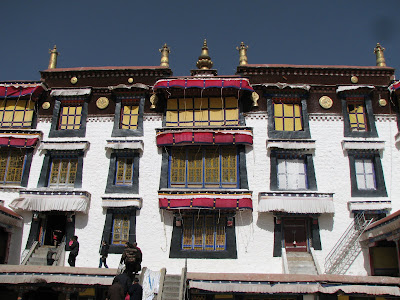
Because it was the New Year, there were a lot of visitors around, and a lot of Tibetans that had returned home from work in the mainland. The Tibetans are a very spiritual or superstitious lot, and many of the temples were jam-packed. Unfortunately, we were not able to enter the famous temples due to day-long line lengths, but that just gives us a reason to go back someday. The most famous landmark in Lhasa is the
Potala Palace.


The first pic is the most famous place angle of the palace. It is a little surprising to find out that the Palace has a front lawn, and really isn't on a cliff (as you can see from the second pic). Nonetheless, the scale of the Palace is enormous. The palace was built in the 17
th century, and was the seat of the Tibetan government, and of course the home of the
Dalai Lamas. We weren't able to tour inside, but it is supposedly barren anyway. I've read that the Chinese do want to recognize it as a famous Chinese landmark, but not a Tibetan national landmark, so they have removed a lot of the
palatial furnishings. From our hotel roof, we were lucky enough to get a glimpse of the
Potala Palace at night. It is all lit up, and is truly beautiful. I had to zoom to get the shot, sorry about the quality.

The next famous site in Lhasa is the
Jokhang Temple. While we were there the temp
 le
le was abuzz with pilgrims. The temple seemed to permanently feature a line that completely wrapped around the square. The
Jokhang is the oldest temple in Lhasa. Tibetans believe that the land used to be cursed, and recognize the land as a
demoness. Before Buddhism could take root in Tibet, temples had to be built on certain parts of the
demoness to pin her down. Therefore, there are holy temples all over Tibet said to be pinning down the
demoness' hands or feet, but the
Jokhang is the most holy because it was the last to be pinned down right over her heart. That is why Buddhist pilgrims from all over the world come to the
Jokhang temple. As you can see from the picture to the right, fresh air can be a commodity in the center of the square as pilgrims toss offerings into the fire.

As you can see from above, the temple square is busy with activity. There are alleys all around the square, but one special one that leads pilgrims in a loop around the temple

. Tibetans call this loop a
kora. As they walk clockwise around the temple, over and over again, they spin prayer wheels, chant mantras, and hang prayer flags. The most dedicated pilgrims do the
kora on their knees, or prostrating themselves along the way. To the right is the main alleyway. Vendors on the left, pilgrims in the middle, and a line of people waiting for the temple against the wall on the right. Below you can see some pilgrims in front of the main entrance of the
Jokhang Temple. Pilgrims aren't the only people walking the
kora, however, vendors line the alleys with all sorts of Tibetan "relics". All the vendors assured us that these were the real thing, and that they were very old. It is more likely that they were recently produced in Nepal and the vendors rub dirt on them. But that's all part of the fun.


There's also a more fun method to getting your prayers heard, by balloon! Many you ngsters were out in the main square tying their prayer flags to balloons and letting them fly high into the Tibetan sky. Another popular method is the giant prayer wheel. Along the kora were a few small buildings that contained these giant, bronzed prayer wheels, which you can see a picture of below. They were usually very crowded with monks and pilgrims chanting as they followed clockwise with the wheel. The wheels are inscribed with mantras like Om Mani Padme Hum. Lastly to the right you can see some of the bling that sparkles atop the Jokhang Temple. There are many Buddhist symbols up top, and if you're lucky enough, you can go to the roof at the right time of day (we couldn't even get inside because of the lines).
 We were lucky enough to have a great hotel location. There are tons of thin, little alleys that connect Lhasa to major points like the Jokhang Temple and kora. By the end of our stay, we could navigate these alleys and end up anywhere we needed to be. There is a lot of character to the alleys. Tibetans live, work, eat, and play in the alleys, and we got to be part of it. One fun thing we did in the alleys was go on a pony/horse ride! Many entrepreneurial Tibetans have horses lined up for kids and visitors to ride through the back alleys. We all hopped on a horse for a New Year's day ride. Check out the video below to see how it went.

Get a-long little horsie!
The next blog will be about our exhausting trip to the largest monastery in Lhasa, the Drepung Monastery.
DB & KM

 We also encountered some wild life on our journey up the hill, most notably a yak! I don't know if you've ever seen a yak up close, but it doesn't look like an animal you'd like to tangle with. I got as close as I felt it would like, and then backed away as it stared me down. I can understand his nervousness; after all, since we had been in Tibet we'd tried dried Yak meat, drank Yak butter tea, bought trinkets made of Yak bone, and seen people clothed in Yak fur.
  There were also lots of sheep running around, and I mean a lot. Darbie's favorite one came to meet us half-way up the mountain.


 Chengdu also has a lot of great parks. It's common to see entire families out in the parks either at the kid "fantasy land" where all the little girls wear pretty elaborate princess crowns or the older members playing cards or fishing in the park ponds with bamboo poles for their lunch. Here are some pics that were taken in or around the many parks of Chengdu.

 The picture below is pretty funny too look at it, and of course, it has a funny story. Inside the People's Park is a fun-house set in an abandoned underground tunnel. We had heard that it was pretty tacky, and I don't think the fun-house even reaches that. Articles like the tiger(?) below point the way to the actual fun-house which is just a particle board maze shrouded in complete darkness. After each turn, a motion display of some type pops up and tries to scare people. Unfortunately, all of the displays are of the same or lesser quality as the tiger you see below with most not even working. The scariest thing was the thought of breaking our necks from the total darkness. That was 5 yuan down the toilet.
 We were also lucky enough to partake in some great Western food in Chengdu. Tex-Mex!! It was our second attempt at "Mexican" cuisine, and it came of much better than the first. If you're ever in Chengdu or Shanghai, be sure to hit Peter's Tex-Mex (Sorry, no pics. We were more concerned with eating). There's really not much else to say about Chengdu, so bring on the pandas! The research center is a ways out of town. We decided to take off pretty early because the pandas generally sleep all day after their massive breakfast. The plan worked, and we got to see pandas of all shapes and sizes in action. They have different areas for the pandas based on their size, we decided to see what the big 'uns were up to first. We were greeted warmly.
 We were just in time to see the adult pandas eating. They eat a ton of bamboo, and once one started, we didn't see it stop. Pandas have a special thumb that helps them grasp and hold the bamboo. The peel off the leaves in, hold a bunch in their hand, and start munching. We've got a video of it, after the picture below.

 Going down isn't as easy as going up. He held himself in this position before finally just tumbling to the ground. He was eager to get to his friend below so they could wrestle.
  Close to the adolescent pen is where they keep all the real panda cubs, affectionally called "the babies" by Darbie. I have seen a lot of cute things in my life, but upon seeing "the babies" I had to resist the urge to curl up into the fetal position and melt. Unfortunately, they wouldn't let us take pictures of the babies because they are afraid the babies would get scared. The cubs were very active. They are kept in little rooms with teeter-totters, balls, and climbing towers, and they happily play with all those things. They love to try to squeeze through things, and climb to the top of things, only to fall down to the ground and do it all over again. One room contained four or five babies that were about to be fed. They were amazingly playful with the workers, hugging their legs as soon as they walk in the room. They got very excited when they saw their baby bottles and each time they were given one they would grab it with two paws, shove it into their mouths, and instantly fall onto their backs in glee. Each time this would happen this would draw "awwws" and giggles from the small crowd gathered to watch. Remembering our dear readers, I broke the rules (and got busted), and took a quick shot when a baby panda came over to the window to greet us. He's waving.
 I didn't miss this moment, and we now proudly present the world premiere of Darbie's panda holding video:

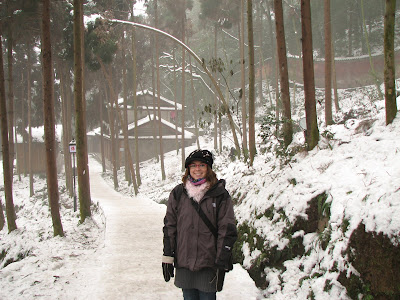 If you look at the path behind Darbie, you'll see what we were dealing with. Packed snow and ice covered the trail. Not too big of a deal until we came to the stair portion of the descent. Our faithful readers will remember that the Chinese prefer concrete stair paths to hiking trails on their mountains; this presents a problem during the winter months. After slipping down a few steps, we were fortunate enough to find home-made Chinese crampons! Kendall was eager to slip some on since all he had on the trip were indoor soccer shoes.
 Pretty hi-tech. But, they actually did the job; no more slips. As you can see, Kendall's foot is a little bigger than the Chinese average. As we hiked further down the mountain, the snow started to melt and disappear. We eagerly made our way to Mt. Emei's most famous attraction, the monkeys!
 These Tibetan Macaques are native to the mountain. There are signs all around the mountain asking visitors not to feed anything other than their special monkey food. We bought a few packs of the monkey food expecting it to last us a good while. Not so. As we entered the habitat where most of the monkeys reside and play, a monkey came over and took all three of our com

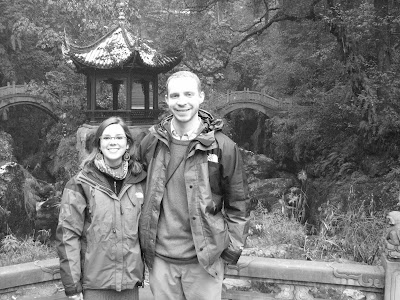 I had to put this picture in black and white, otherwise it would just be a very white blur. At least this way we are supposed to be that white. Below you'll see a pretty cool bridge over some very blue water.